15% DISCOUNT ON YOUR NEXT PURCHASE | SUBSCRIBE
WISDOM, DISTINCTION AND PLEASURE
Curiosities about
Brandy de Jerez
Brandy is undoubtedly one of the world

WHY IS IT CALLED BRANDY?
In the 16th century, an excessive wine harvest led a Dutch chemist to seek a solution to reduce storage and transport costs. To do so, he decided to distill the wine and thus reduce its volume. He called the result "brandewijn". A difficult name to pronounce for the English, who chose to simplify it and call it "brandy".
WHAT MAKES SHERRY BRANDY UNIQUE?
There are many elements behind the taste profile of Brandy de Jerez: the grapes chosen for its production, the criaderas and solera system through which it is made, the unique climate of the sherry triangle, and its ageing in American oak barrels that previously contained the finest sherry wines. The result: an absolutely unique and unparalleled spirit.
CRIADERAS AND SOLERA: A DYNAMIC SYSTEM THAT ORIGINATED IN JEREZ
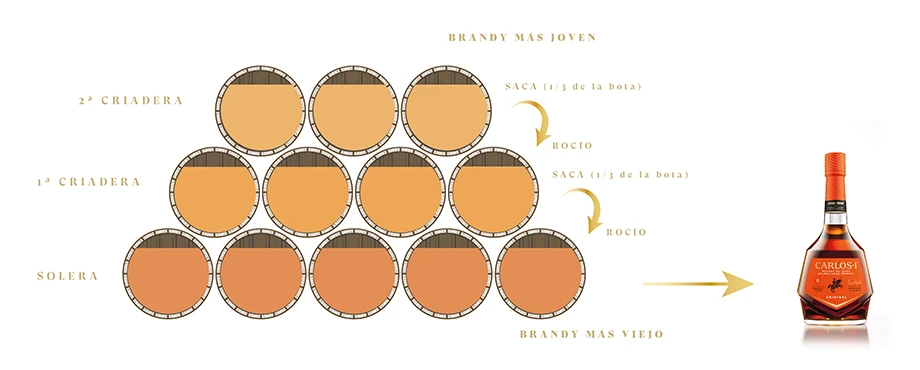
The criaderas and solera system is an ageing system that originated in Jerez in the 19th Century that involves mixing younger spirits with older ones. In the sherry triangle you can find different criaderas and solera ageing systems, depending on the number of scales, or levels of stacked barrels. For example, a solera with three levels of butts stacked on top of one another has three scales. The highest rows are occupied by the criaderas, which are the casks containing the youngest brandy, while the solera holds the oldest brandy, occupying the rows closest to the ground. Brandies ready for bottling will always be extracted from the solera. The "saca", or brandy extracted for bottling, will be replaced with the same amount of wine from the barrels on the first criadera, immediately above the solera.
This replenishment is called the "rocio". In turn, the wine extracted from the first criadera will be replenished with wine from the second criadera, which will lead us to climb step by step up to the upper scale, or "sobretabla", which will be filled up with new wine. It is important to note that the extraction or "saca" is always partial, and never more than a third of the contents of each cask. Therefore, as the barrels are never completely emptied, the product of the soleras will always be a mixture resulting from wines from each and every one of the vintages. This is why brandies made using this system are never labelled with a vintage. It also means that the quality is maintained year after year.
WHAT IS THE DIFFERENCE BETWEEN BRANDY AND COGNAC?
The main differences between brandy and Cognac are based on four aspects: origin, raw material, distillation and ageing.
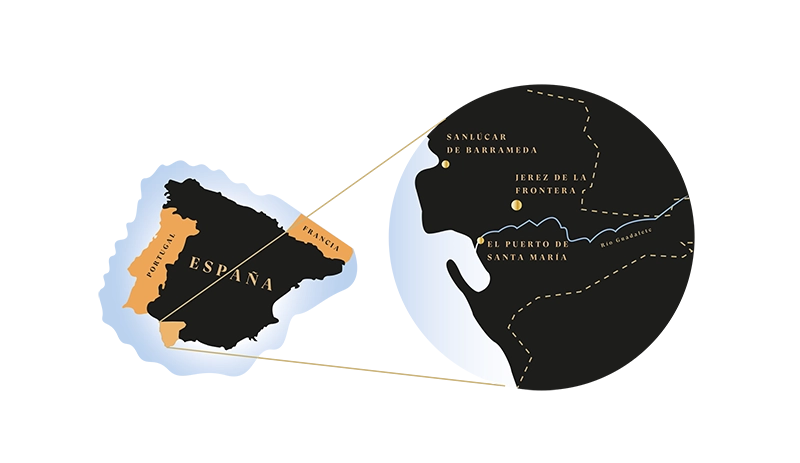
Location: Brandy de Jerez can only be produced in the towns of the sherry triangle (Jerez de la Frontera, El Puerto de Santa María and Sanlúcar de Barrameda). Cognac can only be made in the French region of the same name.
Grape: Brandy de Jerez uses Airén or Palomino grapes; Cognac can only be made with the white varieties Ugni Blanc, Colombard and Folle Blanche.
Distillation: Brandy de Jerez can be made through the distillation process in alembic stills, alquitaras or both. However, Cognac is made through double distillation in a Charentais still, a classic copper still.
Ageing: Sherry brandy is aged in American oak barrels previously used to age sherry wines, which are rich in tannins and creamy aromas. Cognac, on the other hand, is aged in new French oak barrels (Limousin or Tronçais), which provide spicier notes.
WHAT IS THE DIFFERENCE BETWEEN BRANDY AND WHISKY?
Brandy and whisky are two of the most iconic spirits in the world, different in essence, but with some points of similarity, such as the use of sherry casks, the famous sherry barrels appreciated globally for contributing quality and finesse.
Raw material: Brandy is distilled from wine made from grapes, while whisky is obtained from cereals such as malted barley, rye or corn.
Ageing: Sherry brandy is aged through the criaderas and solera system in American oak barrels previously used for sherry wines. Whisky matures in oak barrels of different origins (USA, Hungary, France...), which previously contained bourbon, sherry or port wines.
Origin: Whisky is produced all over the world; Brandy de Jerez can only be made in the sherry triangle.
Many whisky lovers, when they discover Brandy de Jerez, also end up becoming loyal fans of this spirit.


WHAT IS THE DIFFERENCE BETWEEN BRANDY AND RUM?
Rum is an alcoholic beverage obtained from the fermentation of sugarcane juice and derivatives such as molasses, followed by its distillation.
Unlike brandy, there is no rigid production method for rum, but traditional styles that vary according to origin.
It is mainly produced in the Caribbean and Latin America.


FUNGI & SPIDERS
The stone walls of traditional wineries are covered by a black layer of fungus that feeds on the steam resulting from distillation. This fungus also proliferates in underground areas, where it coexists with spiders, great allies of winemakers, as they are responsible for eliminating termites, the main enemies of wood in barrels.

MORE COLOUR DOES NOT MEAN MORE AGEING
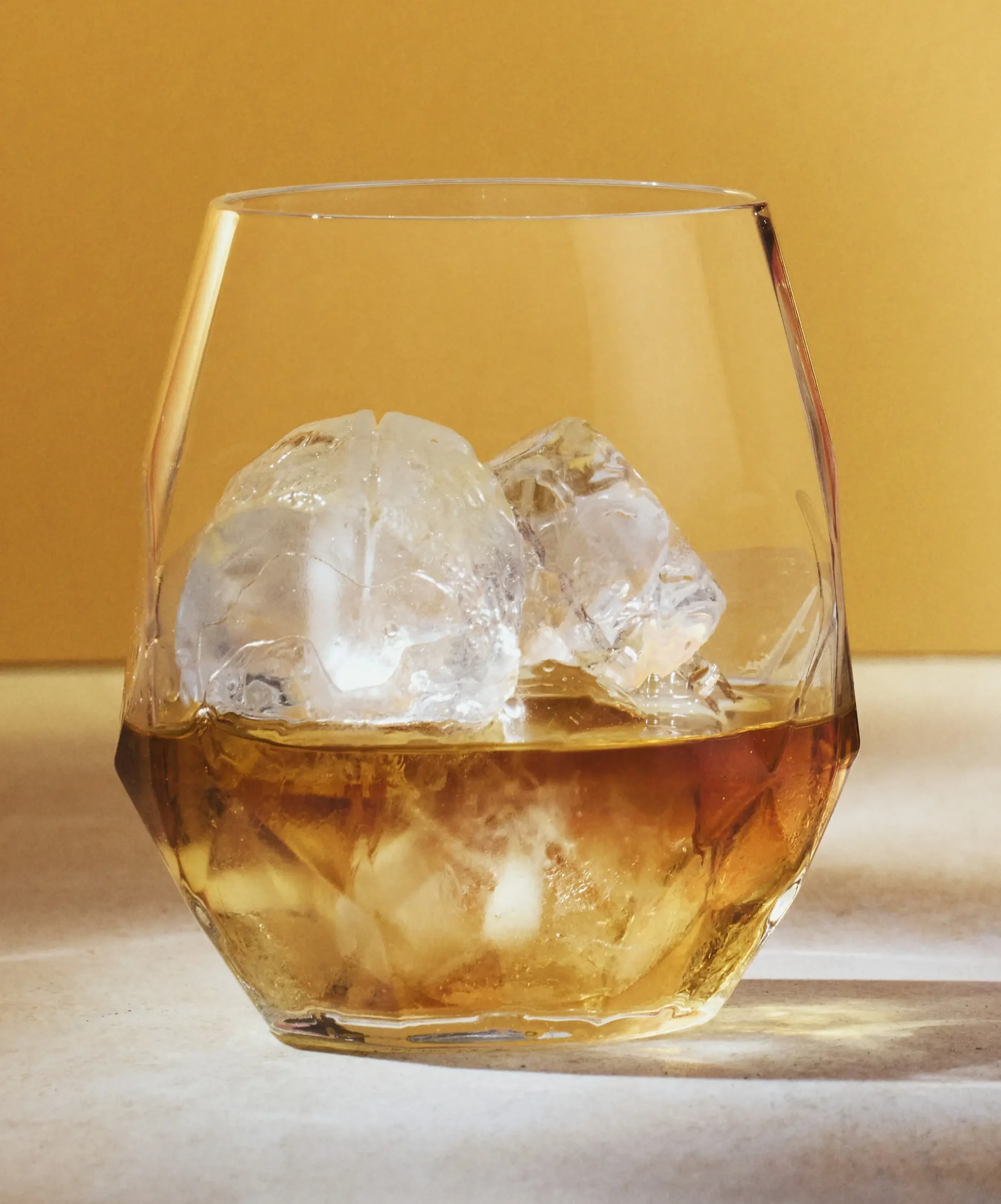
Brandy ages in oak casks, and the more time it spends in them, the more complex and nuanced the brandy becomes. During this process, the drink naturally gets darker. However, some producers add colour to provide sweetness and caramelised tones. Therefore, a dark colour does not guarantee that the brandy has been aged for decades.
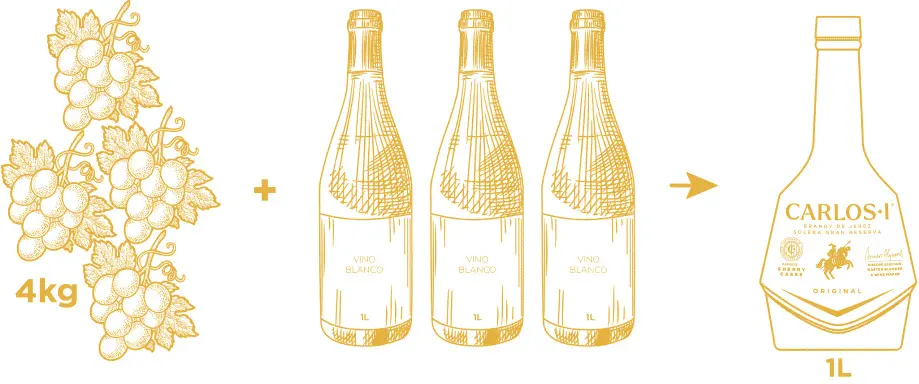
3 LITRES OF WINE TO MAKE EACH BOTTLE OF CARLOS I
Each year, more than 50 million kilos of grapes are used to make Brandy de Jerez, which requires more than 10,000 hectares of vineyards. It is no coincidence that Spain is known as "the great vineyard of the world".
Brandy is obtained through the distillation of wine, which after long ageing, is transformed into a more noble and refined beverage. To produce a single bottle of our Carlos I Brandy you need around 3 litres of wine and about 4 kilos of grapes.